How can we help?
Straight answers to the questions employers and employees ask us most about EV salary sacrifice.
Browse by topic
How it works
The basics: what salary sacrifice is, what you save and the tax.
For employers
Cost, admin, payroll, eligibility and the Zero Risk Guarantee.
For employees
Eligibility, your pay, and life changes during the lease.
Cars and what's included
New and used cars, live prices and what the monthly cost covers.
Charging and running costs
Home chargers, the Charge Card, range and pay-per-mile tax.
Why loveelectric
How we compare, our guarantee, reviews and referrals.
Start with these guides




How it works
What is EV salary sacrifice and how does it work?+
EV salary sacrifice lets an employee lease an electric car through their employer. The monthly cost comes out of their gross salary before Income Tax and National Insurance are worked out, so they pay less tax. Electric cars also have a low Benefit-in-Kind rate (4% in 2026/27). Together, that typically makes an EV 30–60% cheaper than leasing the same car personally. With loveelectric, the employer joins for free and the employee chooses a new or used EV. Servicing, maintenance, tyres and breakdown cover come in one monthly price, and insurance can be added.
How much can I save on an electric car through salary sacrifice?+
Most employees save 30–60% compared with leasing the same car personally. Your saving depends on your salary, tax band and the car you choose. The higher your tax band, the more you save. For example, a 40% taxpayer sacrificing £500 a month saves about £210 in Income Tax and National Insurance and pays about £50 in Benefit-in-Kind tax. Every car on loveelectric shows a live monthly price with the saving already worked out, and you don't need to sign up to see it.
Is salary sacrifice cheaper than personal leasing for an electric car?+
For most drivers, yes, typically by 30–60%. Salary sacrifice payments come out of your gross salary before tax and National Insurance. A personal lease is paid from your take-home pay. Salary sacrifice also includes servicing, maintenance and tyres in the monthly price, with insurance as an option. A personal lease typically doesn't cover them.
Is an electric car salary sacrifice scheme worth it?+
For most employees, yes. It's one of the cheapest ways to drive a new or nearly-new electric car: there's no deposit and no personal credit check, and the running costs are in the monthly price. It suits you less well if your pay is close to the National Minimum Wage, or if you plan to leave your job soon. If you're about to apply for a mortgage, take advice first, because many lenders look at your salary after the sacrifice.
Do I pay Benefit-in-Kind tax on a salary sacrifice electric car?+
Yes, but at a low rate: 4% of the car's list price (its P11D value) for the 2026/27 tax year, far below the rates for petrol and diesel cars. loveelectric's quotes already include it, so the monthly figure you see is the estimated drop in your take-home pay.
Is there a credit check for EV salary sacrifice?+
Not for employees. Employees don't apply for car finance themselves, so there's no personal credit check. The business goes through a standard credit check with our funders, as with any company car lease. Applying is no-commitment and doesn't affect the company's credit rating or the directors' personal credit ratings.
How do I sign up?+
It’s easy. Whether you’re an employer or employee, you can speak to our advisers here.
How much does a salary sacrifice car cost per month?+
It depends on the car, your tax band, contract term and annual mileage - there’s no single figure that applies to everyone, which is exactly why we suggest getting a feel for the figures by searching our catalogue of cars, for free.
Guides on this topic










For employers
Does offering an EV salary sacrifice scheme cost the employer anything?+
No. It costs nothing to join, run or manage loveelectric's scheme. Our monthly service fee for each participating employee is never more than the employer National Insurance the scheme saves, so the scheme is cost-neutral. Our Zero Risk Guarantee is cost-neutral too: a small fee goes on the employee's monthly price, not the company's.
How much admin does an EV salary sacrifice scheme take?+
Most employers spend 15–30 minutes a month on it. You approve employees' orders and make one adjustment to payroll. We provide a monthly payroll report, templates and an easy-to-follow guide for that adjustment. loveelectric runs the eligibility and minimum wage checks, onboards your employees and supports them for the whole lease.
Does EV salary sacrifice work with our payroll and HR systems?+
Yes. loveelectric sends a simple monthly payroll report designed to work with most UK payroll systems. Deductions run through your existing payroll: each month your team makes one adjustment, using our templates and guide.
How do we roll out an EV salary sacrifice scheme to employees?+
With loveelectric it takes four steps:
- Demo. A short call on how the scheme works and how it stays cost-neutral.
- Application. A 5-minute, no-commitment form that checks your business is eligible. It doesn't affect your company credit.
- Agreement. Once our funders approve you, you sign our supplier agreement.
- Launch. Our Customer Success team sets up your account. We give you a ready-made comms toolkit with employee explainers, FAQs and info sessions.
Employees then browse and order cars, and you approve each order. Take-up builds over the first 3, 6 and 12 months, so keep promoting the scheme after launch day.
How quickly can a company launch an EV salary sacrifice scheme?+
Set-up can take as little as 7 days. The timing depends mostly on how quickly our funders approve your application, which takes about 5 minutes to fill in. If you already know you want the scheme, you can skip the demo and apply straight away.
Is my business eligible? Is there a minimum number of employees?+
There's no minimum number of employees. Your business needs to have been trading for at least two years, and to be profitable and/or have a net worth of £500,000 or more. A one-person limited company can qualify too, as long as the director is paid through PAYE. Checking eligibility doesn't affect your company's credit rating.
What happens if an employee leaves while they have a salary sacrifice car?+
loveelectric's Zero Risk Guarantee covers resignation, redundancy and dismissal from the first day of the lease. Your business doesn't pay the leasing company's early termination charge. Instead it owes a capped fee: three months' rental in the first three months of the lease, or one month's rental after that. You can recover that fee from the employee's final pay. There's no cap on how many leavers are covered each year. Cover applies while your staff turnover is below 15% a year, and cars already covered stay covered if turnover rises later.
Can schools and academy trusts offer EV salary sacrifice?+
Yes. Under the Department for Education's 2026 guidance, most academy trusts can offer EV salary sacrifice without DfE approval. The condition is that the scheme leaves the trust with no cost or liability, or that any liability is fully mitigated. Trusts under a Notice to Improve, or using a scheme outside the standard master hire agreement model, still need DfE approval. loveelectric's scheme is built to meet each DfE condition. The Zero Risk Guarantee covers resignation, redundancy, dismissal and long-term sickness from Day 1. We, not the trust, handle re-hiring or taking back the car. Deductions run through your existing payroll.
What employee uptake can we expect from EV salary sacrifice?+
It depends on your team's salaries, demographics and parking, and on your existing car policy. Take-up usually grows over the first 3, 6 and 12 months rather than peaking at launch. It's often highest in smaller companies, where the benefit is very visible across the team. Schemes do best with steady promotion: line managers mentioning it, colleague stories and quarterly reminders. loveelectric provides the comms toolkit, onboarding check-in calls and account management to keep it going.
How does EV salary sacrifice work with National Minimum Wage rules?+
Salary sacrifice can't take anyone's pay below the National Minimum Wage. For employees aged 21 and over that's the National Living Wage: £12.71 an hour from 1 April 2026. Younger employees have the rate for their age. loveelectric checks this when each employee enters their salary, and only shows them cars that keep their pay above the limit. The employer just confirms the salary is correct when the order is placed.
Is Zero Risk Guarantee automatically included when I sign up?+
Yes. From February 2026, Zero Risk Guarantee is included as standard from Day 1, giving all clients complete peace of mind.
How liable are we for unexpected costs?+
Our Zero Risk Guarantee (ZRG) ensures your company isn't left with early termination fees if an employee leaves or something goes wrong unexpectedly.
I'm concerned I don't have the expertise to evaluate if this is right for my business.+
You don't need any prior experience to get started. If you haven't already, use our eligibility checker to see if your business qualifies. That's usually a strong indication as to whether the scheme is right for your business. If you're still unsure - then get in touch.
If it's cost-neutral, how do you make your money?+
Our service fee is the equivalent of the Employer's NIC Savings - ensuring it remains cost-neutral for your business. As a B Corp certified business, our pricing is transparent in order to prioritise employee savings and employer trust over short-term profits.
Is the Zero Risk Guarantee really cost-neutral for my business?+
Yes. Our Zero Risk Guarantee is entirely cost-neutral for employers. A small, negligible fee is added to the employee’s monthly lease price, ensuring your business gains complete assurance without any financial burden.
What does the Zero Risk Guarantee include?+
Built to remove early termination uncertainty, our Zero Risk Guarantee gives your business Day 1 assurance against unexpected costs — from resignation through to redundancy.
What happens if our company's attrition rate goes above 15%?+
If your attrition rate is below 15% at the point a vehicle is delivered, that vehicle will qualify for the Zero Risk Guarantee for the full lease term. This remains unchanged even if your attrition rate increases above 15% later on.
If your attrition rate exceeds 15% prior to a new vehicle’s start date, that vehicle will not fall within the scope of the Zero Risk Guarantee. Vehicles already in place at the time will remain unchanged under the Zero Risk Guarantee terms.
Wouldn't employees prefer a payrise instead?+
Thanks to our used vehicles, our scheme is financially accessible to all employees. However, non-financial renumeration is becoming increasingly important for more experienced talent - especially those who earn over £100,000 and enter the 60% 'tax trap'. Our scheme helps senior talent be more tax efficient whilst remaining completely cost-neutral to the business.
Guides on this topic






















For employees
Can I get EV salary sacrifice on a lower salary or part-time hours?+
Yes, as long as your pay after the sacrifice stays above the National Minimum Wage (£12.71 an hour if you're 21 or over, from April 2026). What counts is your pay, not your hours, so part-time staff qualify on the same terms. loveelectric only shows you cars that keep you above the limit. Our used reloved® cars cost less each month, which opens up more choice on a lower salary. You need a contract of employment and to be paid through PAYE, so zero-hours workers usually can't join.
Does EV salary sacrifice affect my pension, mortgage or student loan?+
It can affect all three, because it lowers your gross salary.
- Pension: if contributions are based on your salary, yours and your employer's may fall slightly.
- Mortgage: many lenders work out affordability from the post-sacrifice salary on your payslip. Some will use your pre-sacrifice salary if you show them an employer letter or earlier payslips.
- Student loan: repayments are based on gross pay above the threshold, so they could go down.
Your P60 will show your salary after the sacrifice. If you're about to apply for a mortgage, get independent financial advice first.
What happens to my salary sacrifice car if I leave my job?+
Your salary sacrifice agreement ends when your job does, so you usually hand the car back. If your new employer runs a compatible scheme, the lease can move with you, or it can pass to an eligible colleague. When you leave, your employer may take a capped fee from your final pay: one month's rental, or three months' rental if you leave in the first three months of the lease. You won't face the leasing company's full early termination charge, because loveelectric's Zero Risk Guarantee covers your employer from Day 1.
What happens to my salary sacrifice car if I go on maternity leave?+
You keep the car as long as your pay during leave stays above the higher of the National Minimum Wage and Statutory Maternity Pay (£194.32 a week in 2026/27). Your deductions carry on as normal. If your pay drops below that, you return the car, loveelectric relists it on our reloved® marketplace, and you pay a capped fee. That's typically one month's rental if you're past month three of the lease; in the first three months, the leasing company's standard early return charge may apply instead. Your employer pays nothing. The same rules cover paternity, adoption and shared parental leave, and you can apply for a car again when you return to work.
Can I spread the deposit across more than 3 months?+
Currently, you're only able to spread the deposit amount across the first 3 months of your lease.
Do I have to put down a deposit when ordering a car?+
Nope. Dynamic Deposits are completely optional. If you want to pay a flat fee throughout your lease term from the beginning, then simply select Level 1 at point of ordering.
How much of a discount will I receive by placing a deposit?+
The benefits of increasing your payments in the first 3 months are two-fold. Firstly, your monthly payments from Month 4 to the end of your lease term, will be lower. Secondly, we offer an additional discount on top of the salary sacrifice savings. The higher the level of deposit, the more discount you'll receive.
What's the maximum amount of deposit I can put down?+
There's no set figure, as it depends on a multitude of factors such as your salary and lease cost. We offer 5 levels of deposit; 1 being no deposit and 5 being the maximum deposit available. If a higher level of deposit would bring your salary below the minimum wage, then it'll be restricted from view at the point of ordering.
Guides on this topic












Cars and what's included
What's included in the monthly price?+
Your car (new, or reloved® used), servicing and maintenance, MOT, breakdown cover and recovery, replacement tyres and glass, accident management and customer support. You can add fully comprehensive insurance to the same monthly payment, and get a fully installed home charger at a discount. There's no deposit unless you choose one: an optional Dynamic Deposit lowers your monthly payments from month 4.
Can I get a used electric car through salary sacrifice?+
Yes. loveelectric's reloved® cars are used EVs between 12 and 48 months old, each with only one previous registered keeper. They come with the same all-inclusive package and the same salary sacrifice savings as a new car, plus the lower price of a used one. Every listing shows the car's age, mileage and details. Most manufacturers warranty EV batteries for 8 years or 100,000 miles, so the drop in battery capacity is usually negligible.
How long is the lease and what mileage can I choose?+
You can choose a 24, 36 or 48-month contract with up to 15,000 miles a year. You'll see a full breakdown of the monthly cost for your chosen term and mileage before you commit.
How many previous owners have reloved® cars had?+
All vehicles listed will have only had one previous registered keeper.
How old are reloved® cars?+
Our used cars are between 12m - 48m old. We'll occasionally receive cars that have been returned early, which can be less than 1 year old. Age, mileage and other details are outlined for every car.
What’s not included as part of the deal?+
As we’re transparent about all aspects of our offering, it’s only fair that we also outline what’s not included as part of the deal:
- A test drive of the car
- Our own charging network
Will I still save up to 60% off with salary sacrifice?+
Yes. The salary sacrifice scheme works just the same for used EVs as it does with brand new vehicles. That means up to 60% off the monthly lease cost, as well as the discount on offer with a used car.
Will the range of a used electric car be less than a brand new one?+
Most manufacturers now offer a 100,000 mile or 8-year warranty on their EV batteries. All reloved® vehicles are less than 48m old and have only had one previous owner, so are typically only subject to a negligible drop in capacity.
How much does a Tesla Model Y Hatchback cost per month through salary sacrifice?+
On loveelectric, a new Tesla Model Y Hatchback costs from £391 a month: a saving of 39%. That's the lowest price, for an additional-rate (45%) taxpayer on a 48-month lease with 5,000 miles a year, for the entry-level version, and it shows how much your take-home pay would go down. A higher-rate (40%) taxpayer pays £408 a month. Prices update daily, and you can see your own price on the Tesla Model Y Hatchback page.
Guides on this topic













Charging and running costs
Is a home charger included with an EV salary sacrifice car?+
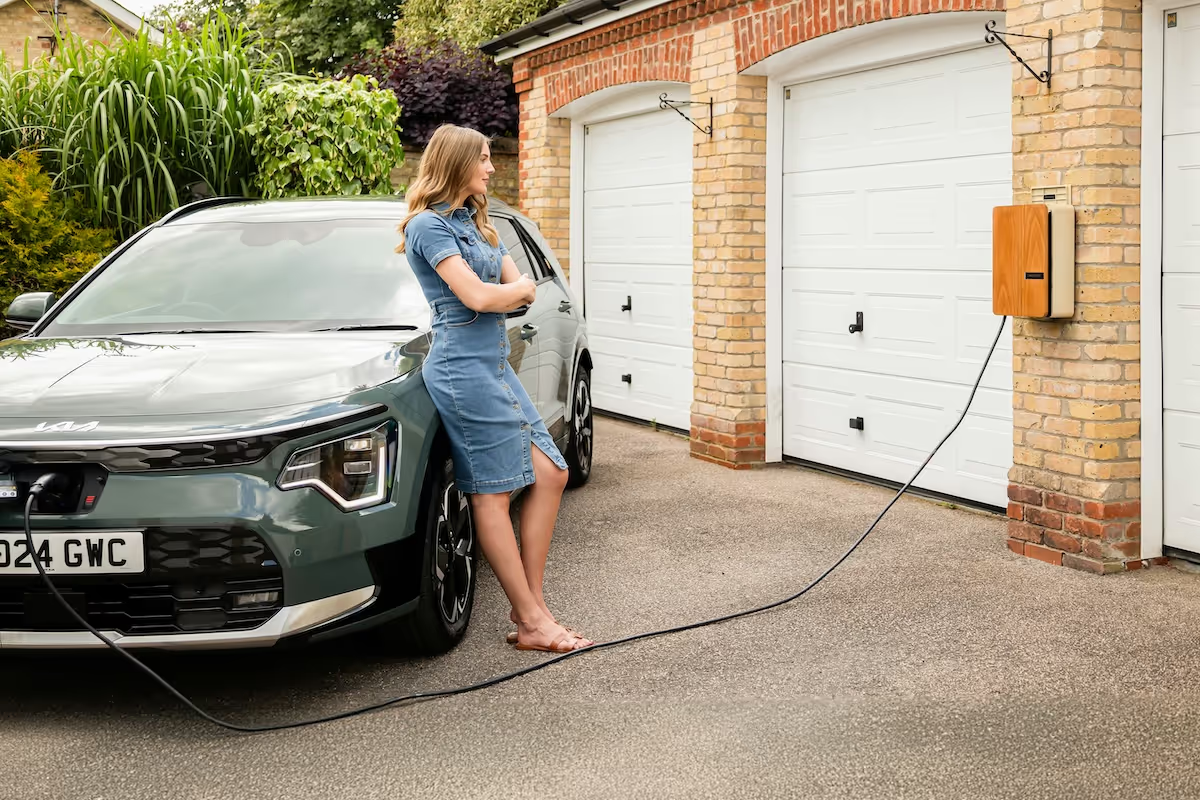
Not automatically, but you can add one at a discount. Through loveelectric's partnership with Hypervolt, you can pay for a fully installed 7kW smart charger through salary sacrifice in the first month of your lease and save up to £500. Or you can spread the cost with Pod and get an exclusive £100 discount. A standard installation takes 2–3 hours. If your employer also offers the loveelectric Charge Card, your public and home charging can go through salary sacrifice too, at every UK charger.
Can I charge my EV with solar panels?+
Yes! Using renewable energy produced at home is the most cost effective (aka. free), convenient and environmentally friendly way to recharge. Our friends at Hypervolt have streamlined this process.
Do different EVs require different chargers?+
All chargers are technically able to provide a charge to an EV - however you first need to check whether they have the correct connector type for your vehicle. See below.
How long will it take to charge my car?+
To calculate the charge time: Battery size (kWh) ÷ Charger power (kW) = Charging time (hours)Let’s use a 60kWh battery as an example:
At home: With a 7kW charger - such as the Hypervolt 3.0 - a charge from 0-100% takes 8.5 hours.
Public charging: With a 150kW rapid charger - such as the Tesla Supercharger - most new EVs can charge up to 80% in around half an hour.
How long will it take to install my EV charger?+
Standard installations typically only take between 2-3 hours.
How much does an EV home-charge point cost?+
Through our partnership with Hypervolt, you can save up to £500 on a premium, fully-installed, 7kW smart home charger through salary sacrifice.
How much will it cost to charge my car?+
To calculate the cost: Battery size x Tariff cost (pence per kWh) = Cost to charge (£s)Let’s use a 60kWh battery again as an example:
At home: Smart charging using an EV-friendly tariff is the cheapest way to charge. OVO Energy’s ‘Charge Anytime’ tariff is 10p/kWh, meaning a full charge costs only £6.
Public charging: Rapid charging at service stations is the most expensive way to charge. The average cost is 70p/kWh, meaning a charge to 80% would be £33.60.
Should I charge my car every night?+
It isn’t necessary to charge your car every night, although most drivers like to keep their battery topped up to 80%.
What are the different connector types?+
Type 2 and Combined Charging System (CCS). Every electric vehicle on sale today is equipped with a Type 2 plug, with the vast majority of cars also coming with a CCS, too.
How does home charging work with the Charge Card?+
Drivers record their home charging sessions in the Charge Card app. We calculate the total cost of those sessions and make that amount available for them to pay their home energy provider directly using their Visa Charge Card.
How is the Charge Card's monthly allowance calculated?+
Employees estimate their annual mileage and charging habits using our online calculator. We use this to determine a fair, HMRC-compliant salary sacrifice amount that covers their expected charging costs.
Does the Charge Card cover all chargers?+
Yes. Because it’s a Visa card, the Charge Card offers 100% UK charger coverage, including Tesla Superchargers and regional networks. Drivers can also use it for home charging with any energy provider.
How does the Charge Card stay HMRC-compliant?+
The Charge Card follows HMRC’s requirements for company car drivers. Each employee’s allowance is pre-agreed and fixed for a 12-month term, ensuring it qualifies as a valid salary sacrifice arrangement. Our model was built with input from leading tax advisors.
What happens to unused Charge Card balance, or if an employee leaves?+
Any remaining balance is refunded to the employer, who can then credit the employee through payroll. This keeps things fair, compliant and easy to manage.
Can I use the Charge Card for business miles?+
The Charge Card is currently designed for personal EV charging costs. If you also drive business miles, we'd recommend keeping your salary sacrifice based on personal charging only to stay compliant with HMRC guidelines. We're actively developing a solution to handle business mileage reimbursement through the Charge Card.
Will I pay pay-per-mile tax on a salary sacrifice car?+
Yes — eVED applies to any fully electric or plug-in hybrid car from 1 April 2028, regardless of how it's financed, including cars on a salary sacrifice scheme. It's a separate charge from your monthly sacrifice, based on your mileage (Source: GOV.UK — Electric Vehicle Excise Duty (eVED)).
Is an electric car still cheaper than petrol with pay-per-mile tax?+
Yes. Even with eVED added, running an electric car works out at roughly 10p a mile on home charging (7p electricity plus 3p eVED), against around 20p a mile for a typical petrol car at current fuel prices — before the additional savings salary sacrifice delivers on the cost of the car itself.
How much is pay-per-mile tax if I drive 15,000 miles a year?+
At 15,000 miles a year, eVED for a fully electric car works out at £450 a year, or £37.50 a month, at the published 3p-per-mile rate (Source: GOV.UK — Electric Vehicle Excise Duty (eVED)).
Does pay-per-mile tax replace road tax for electric cars?+
No. eVED is an additional charge on top of standard Vehicle Excise Duty (VED), not a replacement for it. Electric cars will continue paying the standard £200 annual VED rate as well as the new mileage-based eVED charge from 2028 (Source: GOV.UK — Electric Vehicle Excise Duty (eVED)).
When does pay-per-mile tax start in the UK?+
eVED starts on 1 April 2028. It applies to fully electric, plug-in hybrid and hydrogen fuel cell cars from that date; petrol and diesel cars are not affected (Source: GOV.UK — Electric Vehicle Excise Duty (eVED)).
Guides on this topic









Why loveelectric
How is loveelectric different from other EV salary sacrifice providers?+
loveelectric is a broker: we source cars from several funders instead of funding our own. That gives employees a wider choice and competitive monthly prices. We offer new and reloved® used electric cars. Employers get our Zero Risk Guarantee from the first day of every lease, with no cap on how many leavers it covers. Our Charge Card works on every UK charging network, and you don't have to switch energy supplier. We're also a certified B Corp. See how we compare with Octopus EV and The Electric Car Scheme.
Can I refer my own business?+
Unfortunately, you cannot refer your own business. However, you can still benefit from our salary sacrifice benefit by signing up your own business with loveelectric.
How do loveelectric's lease prices compare to others?+
As a broker, we work with the industry's largest leasing companies to give our customers access to the broadest deals and cheapest pricing. We're big on pricing transparency, which is why you can get an indicative quote for any of our cars on our website - no signup or filling in annoying forms required.
How many businesses can I refer?+
You can refer as many business leaders as you like: there's no limit!
However, the referral commission is only valid for one referrer per business. For example, if you refer three decision-makers from one company, we will give you £250 once that company signs up – not £750.
When will I receive my referral fee?+
Once your referral signs up with loveelectric, we'll notify you. You'll receive your £250 referral fee within 30 days of their sign-up.
Is loveelectric a good alternative to The Electric Car Scheme?+
Yes — loveelectric is a strong alternative to The Electric Car Scheme if you’re after more EV choice, flexible options and support for both businesses and drivers. We offer access to new and used electric cars, built-in charging support, and protections that help make salary sacrifice simple and low-risk.
What’s the difference between loveelectric and The Electric Car Scheme?+
loveelectric and The Electric Car Scheme are both salary sacrifice providers, but there are a few key differences. With loveelectric, you get a wider selection of vehicles, our Zero Risk Guarantee from Day 1, and tools that make it easier for businesses and drivers to get set up and stay supported throughout the lease.
Is loveelectric a good alternative to Tusker?+
Yes — loveelectric is a strong Tusker alternative if you're looking for termination support from Day 1, more competitive pricing and built-in charging savings. Unlike Tusker, loveelectric's Zero Risk Guarantee assures employers from the moment each lease begins, with no qualifying period to worry about.
What's the difference between loveelectric and Tusker?+
Both are salary sacrifice providers, but there are some key differences. loveelectric is a broker, sourcing vehicles from multiple funders to get employees the most competitive rates. Tusker owns and funds its own vehicles, which can limit pricing flexibility. loveelectric also provides termination support for employers from Day 1, while Tusker's Lifestyle Protection begins after 3 months.
Is loveelectric a good alternative to Octopus EV?+
Yes — loveelectric is a strong Octopus EV alternative if you're looking for Day 1 termination support, more competitive pricing and charging savings without an energy tie-in. As a broker working with multiple funders, loveelectric offers a wider range of EVs at better rates, and our Zero Risk Guarantee assures employers from the moment each lease begins — with no qualifying period to worry about.
What's the difference between loveelectric and Octopus EV?+
Both are salary sacrifice providers, but there are some key differences. Octopus EV owns and funds its own vehicles, which can limit vehicle choice and pricing flexibility. loveelectric is a broker, sourcing cars from multiple funders to get employees the most competitive rates. loveelectric also provides termination support for employers from Day 1, while Octopus EV's cover for resignation, dismissal and redundancy only begins after 3 months. And unlike Octopus EV's charging perks — which are tied to the Octopus Energy ecosystem — loveelectric's Charge Card works with 100% of UK charging networks, with no need to switch energy supplier.
Does loveelectric's termination cover have a cap?+
No. loveelectric's Zero Risk Guarantee is unlimited — there's no cap on the number of terminations covered in any given year. Octopus EV's equivalent protection is capped at 10 vehicles or 10% of your fleet annually, whichever is greater. For smaller businesses this may rarely be an issue, but for larger employers running schemes with 50 or more drivers, a cap could leave the business exposed if multiple employees terminate their salary sacrifice agreement within the same year. With loveelectric, every termination is covered regardless of how many there are.
Guides on this topic




Still got a question?
I'm an employer
See how it works for your business in a short call.
I'm an employee
Learn the basics live, or see what you'd pay.
Already a customer?
Your company portal and account questions live in the customer help centre.
Figures are for the 2026/27 tax year. Last updated 9 November 2026.