Are All Electric Cars Automatic? Manual Gears, Driving & What to Expect


Yes, all electric cars are automatic. Every production EV on sale in the UK uses a single-speed transmission with no clutch and no manual gear changes. This is because electric motors work fundamentally differently to petrol or diesel engines - they deliver instant power across the entire rev range, so multiple gears simply aren't needed.
That's the short answer. If you're curious about why EVs don't need gears, what they actually feel like to drive, and whether any manufacturer is trying to bring back the manual gearbox - read on.
Want to see how much you could save on an EV? Read our 9 Salary Sacrifice Car Examples with EV Calculator.
Do Electric Car Have Gears?
To understand why every electric car is automatic, it helps to know how a petrol engine differs from an electric motor.
A petrol or diesel engine produces power by igniting fuel and air within the combustion chamber. This explosion forces the piston downward creating power. Each time a piston completes one of these combustion cycles, it completes a single revolution. This is where the term ‘revolutions-per-minute’ comes from - aka. ‘revs’.
At higher revs, the engine is working harder. The gearbox solves this by offering multiple ratios - lower gears for pulling away, higher gears for cruising on the motorway - so the engine can stay in its "sweet spot" of power as the car speeds up.
Electric motors don’t have this problem. It produces maximum torque (the force that turns the wheels) from the moment it starts spinning - right from 0 rpm. That torque stays strong and consistent all the way up to high speeds. Think of it like a bicycle with a single gear that always feels perfect, whether you're pulling away from traffic lights or joining the motorway.
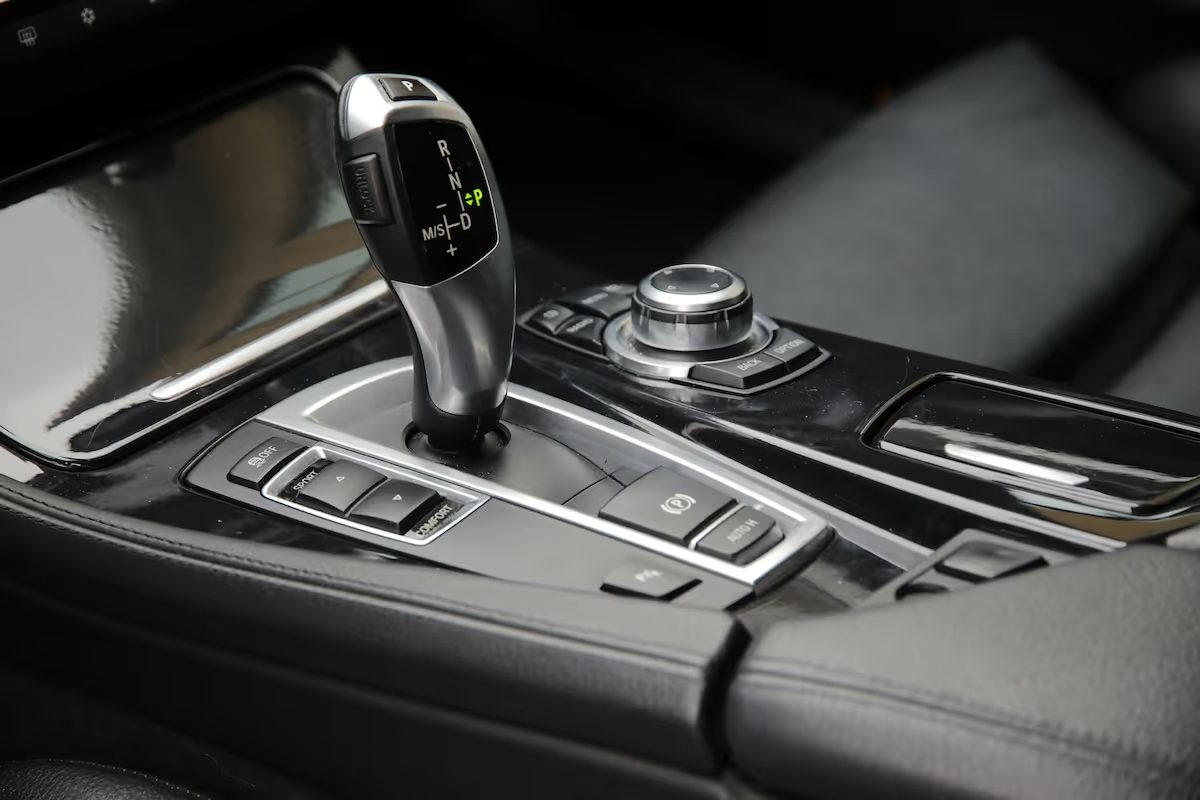
Because the motor's power delivery is so broad and consistent, a single fixed-ratio "gear" is all an EV needs. There's no clutch pedal, no gear lever, and no possibility of stalling. You simply press the accelerator and go.
This isn't a compromise or a cost-saving measure - it's genuinely the most efficient way to transfer an electric motor's power to the wheels. Adding a multi-speed gearbox would introduce weight, complexity, and energy losses with almost no real-world benefit. That's why every major manufacturer - from Tesla and BMW to Hyundai and Volkswagen - uses a single-speed setup across their entire EV range.
Some manufacturers however, are introducing artificial gear shifts (like the Hyundai IONIQ 5N), but more on those later.
Do Electric Cars Feel Different to Drive Than an Automatic Petrol Car?
Yes - but most people find EVs easier and more enjoyable to drive than a conventional automatic.
The biggest difference is the instant response. In a petrol automatic, there's a brief pause when you press the accelerator while the engine builds revs and the gearbox selects the right ratio. In an EV, power delivery is immediate. Press the pedal and the car responds without any hesitation. This makes pulling into gaps in traffic, overtaking on A-roads, and navigating roundabouts feel noticeably more confident.
The other major difference is regenerative braking. When you lift your foot off the accelerator in an EV, the electric motor switches into reverse mode and acts as a generator, converting the car's forward momentum back into electricity to top up the battery. This creates a noticeable slowing effect - enough that many EV drivers rarely need to touch the brake pedal in normal driving. It's often called "one-pedal driving" and, once you're used to it, most people find it more relaxing than constantly switching between the accelerator and brake pedals.
The learning curve is minimal. Most new EV drivers feel completely comfortable within their first hour behind the wheel. If you've ever driven an automatic petrol car, an EV will feel immediately familiar - just smoother and quieter.
Can I Drive an Electric Car With an Automatic-Only Licence?
Yes, absolutely. If you hold a category B automatic-only driving licence (sometimes shown as "B Auto" with restriction code 78 on your photocard), you are legally entitled to drive any electric car in the UK.
Since all EVs operate with automatic transmission - no clutch pedal, no manual gear selection - they fall squarely within the automatic category. There is no additional licence, endorsement, or test required to drive an EV.
This is worth highlighting because, as the UK transitions towards electric vehicles, an automatic-only licence is becoming increasingly future-proof. The UK Government has confirmed that drivers with a category B licence (including automatic-only) can drive electric and hydrogen-powered vehicles - and they even benefit from a higher maximum authorised mass allowance of 4,250kg compared to 3,500kg for petrol and diesel cars.
In short: if you have any valid UK car driving licence - whether full manual or automatic-only - you can drive an EV.
Are There Any Manual Electric Cars?
Not in the traditional sense, no. There is no production electric car on sale today that uses a manual gearbox with a physical clutch and multiple gear ratios. As we've covered, electric motors simply don't need them.
However, a handful of manufacturers are experimenting with simulated gear changes - software systems designed to recreate the feeling of shifting gears, even though the car's drivetrain remains a single-speed unit underneath. It’s an option that many car enthusiasts praise as a ‘best of both worlds’ addition, although implementation is currently limited to a few models.
Hyundai's N e-Shift: Simulated Gears That Actually Work
The standout example is the Hyundai IONIQ 5 N and its "N e-Shift" system. This uses software to simulate an eight-speed dual-clutch gearbox, complete with steering wheel paddles, a digital rev counter, and synthetic engine sounds through the car's speakers.
What makes it remarkable is the depth of the simulation. The system limits torque and applies simulated engine braking to create the impression of eight distinct gear ratios. Miss a gear change and the car cuts power, convincingly imitating a rev limiter. Select the wrong gear for a corner exit and the car bogs down - just like a real gearbox would.
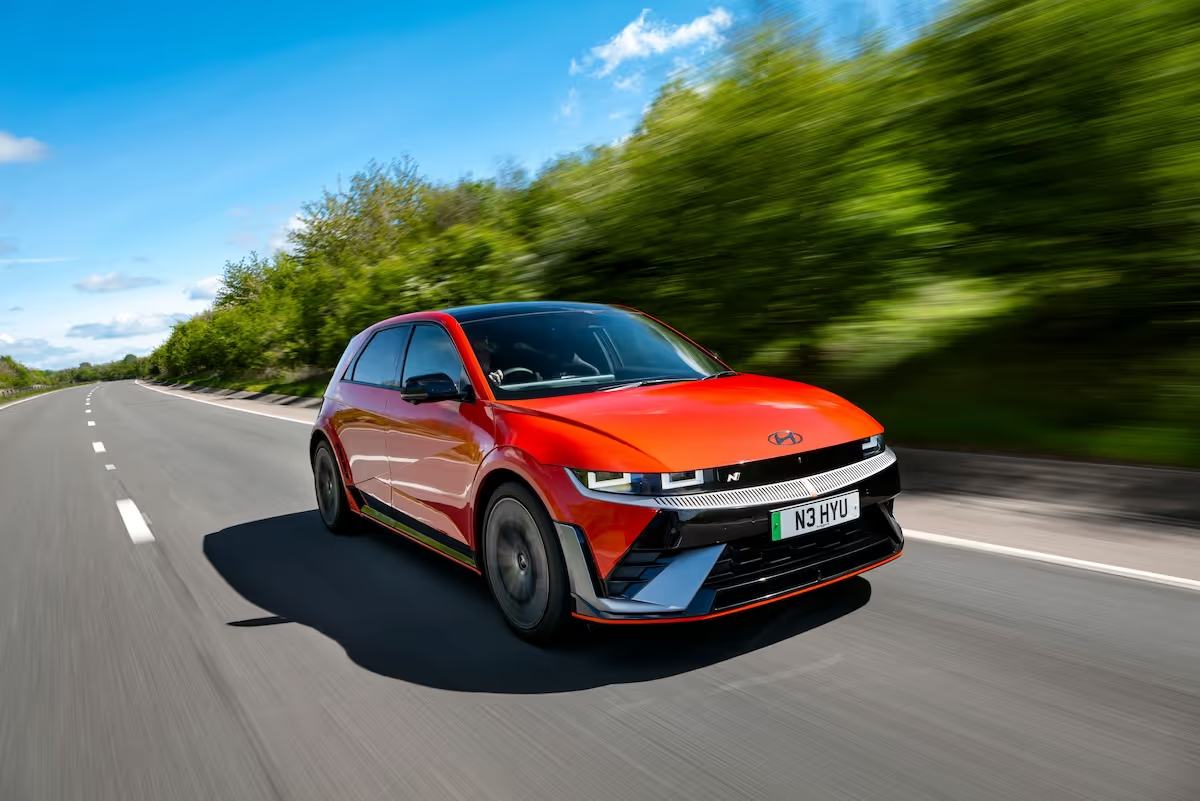
Top Gear described the sound and shifting effects as critical extra dimensions of speed perception, noting that they don't just entertain - they genuinely help the driver judge speed and acceleration more effectively. A separate Top Gear opinion piece conceded that despite initial scepticism, the system proved genuinely enjoyable to use. Motoring Research called the result far more convincing than expected, noting that passengers had no idea the car was electric until the driver switched back to silent normal mode.
The crucial point for this feature: you can switch N e-Shift off entirely at any time, and the IONIQ 5 N returns to driving like a conventional, silent, single-speed EV. The simulated gears are purely optional - the car underneath is still automatic.
Hyundai has since expanded the technology to the IONIQ 6 N, with an updated version of N e-Shift that works across all drive modes - including Eco.
Toyota and Subaru: Simulated Manuals on the Horizon
Toyota is taking the concept even further. The company has developed a simulated manual transmission for EVs that includes a physical clutch pedal, a six-speed H-pattern gear lever, and synthetic engine sounds. Reports suggest a prototype could be arriving shortly, likely in a sporty model based on the FT-Se concept.
Toyota's system goes to extraordinary lengths for authenticity - it even allows the car to "stall" if you release the clutch too quickly, just like a real manual. Both Toyota and Subaru have filed patents for these systems.
It's important to stress: these are all software simulations layered on top of a standard single-speed EV drivetrain. No production EV has a mechanical manual gearbox, and none is expected to. The fundamental answer remains the same - all electric cars are automatic.
What Are the Benefits of Electric Cars Being Automatic?
For most drivers, the fact that EVs are automatic is one of their biggest practical advantages.
Easier in traffic. No clutch means no gear-change fatigue during stop-start commutes. Your left foot gets a permanent rest, and there's no hill-start anxiety - EVs hold themselves on inclines automatically.
Smoother for passengers. Without gear changes interrupting the power delivery, acceleration in an EV is silky smooth. Passengers aren't jolted by shifts, which makes for a noticeably more comfortable ride - particularly for children and those prone to travel sickness.
Simpler to learn. If you're new to EVs, the learning curve is almost non-existent. If you can drive an automatic, you can drive an EV. The transition from petrol automatic to electric is seamless.
Lower maintenance. No clutch to wear out, no gearbox oil to change, and far fewer moving parts in the drivetrain. This contributes to EVs' generally lower running costs compared to petrol cars.
Accessible to all licence holders. As covered above, automatic-only licence holders can drive every EV on the market - no restrictions, no additional tests.
If you're considering making the switch, a salary sacrifice car scheme is one of the most cost-effective ways to get an EV. You could save up to 60% compared to a personal lease, with insurance, maintenance, and breakdown cover typically included. Explore the latest EV deals on loveelectric.
FAQs
Do electric cars have gears?
Not in the traditional sense. EVs use a single-speed reduction gear (sometimes called a fixed-ratio transmission) to transfer power from the motor to the wheels. There are no gear changes - the car handles everything automatically. You won't find a gear lever or clutch pedal in any production EV.
Are all electric cars automatic?
Yes. Every electric car currently on sale in the UK is an automatic - there are no manual electric cars available. The only exception to the rule is the Hyundai IONIQ 5N, which has a selectable mode called N e-Shift. This system simulates gear changes using the flappy-paddles on the steering wheel. This is effectively a piece of software and isn't actually selecting gears.
Do electric cars have a clutch?
No. Electric cars have no clutch pedal and no gear lever. The accelerator directly controls motor output and speed.
Is driving an electric car easier than a manual?
Yes. Without gear changes or a clutch, electric cars are simpler to drive; particularly in stop-start city traffic.
Is regenerative braking automatic?
Yes. Regenerative braking activates automatically when you lift off the accelerator. Most EVs let you adjust the strength of the regenerative braking effect - from barely noticeable to strong enough to bring the car almost to a complete stop without touching the brake pedal. It's completely automatic and requires no input from the driver.
Can someone with a manual licence drive an electric car?
Yes. A full manual category B driving licence entitles you to drive both manual and automatic vehicles. Since all EVs are automatic, any holder of a full UK driving licence - whether manual or automatic-only - can legally drive any electric car.
Are there any electric vans or trucks that are manual?
No. Just like electric cars, all electric vans (such as the Ford E-Transit, Mercedes eVito, and Volkswagen ID. Buzz Cargo) and electric trucks use single-speed automatic transmissions. The same principle applies - electric motors don't benefit from multiple gear ratios, so a manual gearbox would add complexity for no practical gain.
Why don't electric cars need a gearbox?
An electric motor delivers strong, consistent torque from 0 rpm all the way to its maximum speed. A petrol engine needs multiple gears because it only produces useful power within a narrow rev band. Since an electric motor's power band is so broad, a single fixed ratio is the most efficient solution - no gear changes needed.

Live monthly prices for popular electric SUVs


Illustrative prices for a 40% taxpayer on a £55,000 salary, 5,000 miles a year on a 48 month term, for the entry derivative of each model. Shows your estimated take home pay reduction; your own price and saving will vary. Prices update daily.
Live monthly prices for popular electric cars


Illustrative prices for a 40% taxpayer on a £55,000 salary, 5,000 miles a year on a 48 month term, for the entry derivative of each model. Shows your estimated take home pay reduction; your own price and saving will vary. Prices update daily.
Live monthly prices for Chinese electric cars


Illustrative prices for a 40% taxpayer on a £55,000 salary, 5,000 miles a year on a 48 month term, for the entry derivative of each model. Shows your estimated take home pay reduction; your own price and saving will vary. Prices update daily.
Live monthly prices for the cheapest electric cars


Illustrative prices for a 40% taxpayer on a £55,000 salary, 5,000 miles a year on a 48 month term, for the entry derivative of each model. Shows your estimated take home pay reduction; your own price and saving will vary. Prices update daily.
Live monthly prices for small electric cars


Illustrative prices for a 40% taxpayer on a £55,000 salary, 5,000 miles a year on a 48 month term, for the entry derivative of each model. Shows your estimated take home pay reduction; your own price and saving will vary. Prices update daily.
Live monthly prices for 7-seat electric cars


Illustrative prices for a 40% taxpayer on a £55,000 salary, 5,000 miles a year on a 48 month term, for the entry derivative of each model. Shows your estimated take home pay reduction; your own price and saving will vary. Prices update daily.