



In this article
What Is A Salary Sacrifice Car Scheme? The Basics Explained


This article is your super simple guide to the what, who, why, when, where and how of the salary sacrifice car scheme.
What is a salary sacrifice car scheme?
A salary sacrifice car scheme is an employee benefit that allows you to get a car through your employer by giving up (or sacrificing) a portion of your gross salary in exchange for the vehicle. Because the cost comes out of your pay before tax, you typically save on Income Tax and National Insurance, making it one of the most cost-effective ways to drive a car—especially an electric one.
For many people, this means driving a newer, better-equipped car for much less than they’d pay through personal leasing or ownership. That said, salary sacrifice isn’t automatically the best option for everyone. Your savings depend on factors like your salary and tax band, so it’s worth taking time to determine if salary sacrifice is worth it before committing.
Beyond headline savings, the benefits of salary sacrifice for employees often include:
- predictable monthly costs
- fewer unexpected expenses
- and easier access to electric vehicles that might otherwise feel out of reach
What salary sacrifice isn’t: Salary sacrifice is not a salary deduction. Salary sacrifice changes your contractual pay before tax, while salary deductions are taken afterwards. It’s a subtle difference that plays a big role in how the savings are created.
Who can use a salary sacrifice car scheme?
A salary sacrifice car scheme can only be used if both the employer and the employee meet certain criteria. While the specifics vary by provider, the general principles are the same across most schemes.
Being eligible as a business
From a business perspective, a company needs to be set up to offer salary sacrifice as an employee benefit. This usually means being UK-based, trading for a minimum period, and able to support a small amount of payroll administration.
The employer enters into an agreement with a salary sacrifice provider, who handles the vehicles, pricing, and ongoing support.
With loveelectric, the focus is on keeping schemes cost-neutral and low-admin, which makes salary sacrifice accessible not just to large corporations, but also to SMEs that want to offer a competitive benefit without added complexity.
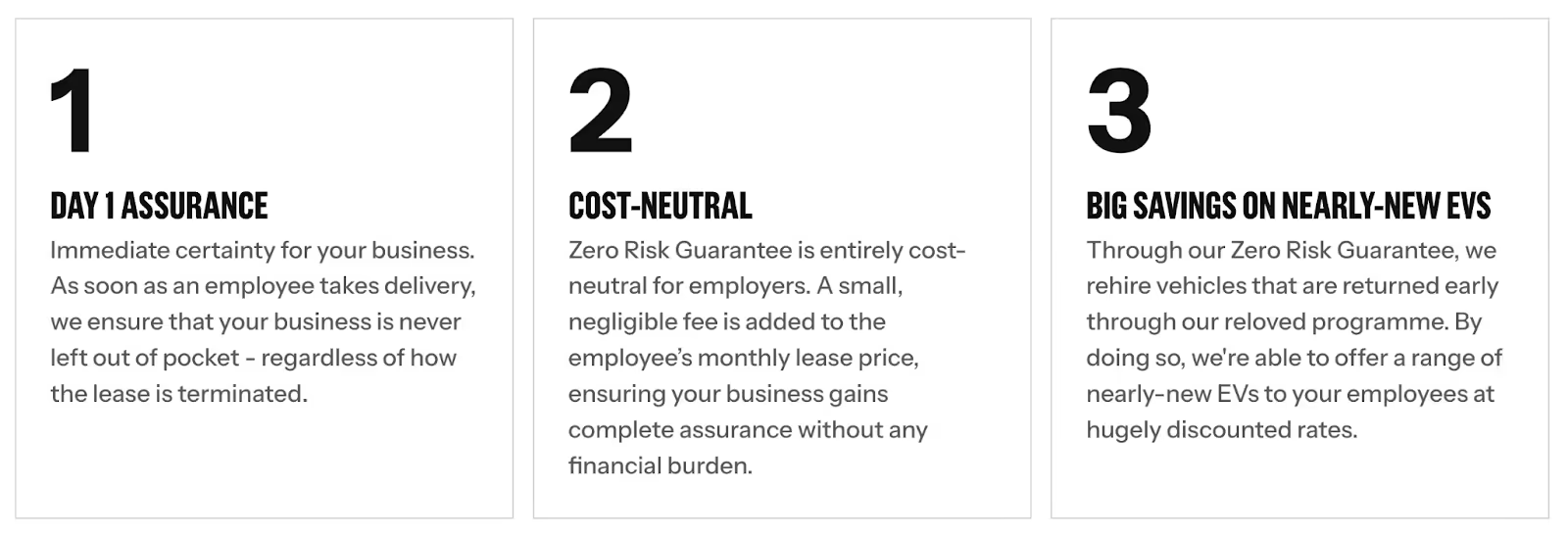
Learn more about loveelectric’s Zero Risk Guarantee.
Find out if you’re eligible for the scheme as a company.
Being eligible as an employee
For employees, eligibility is typically based on employment status and pay. You’ll usually need to be a permanent employee and earn enough to ensure the salary sacrifice doesn’t take your pay below the National Minimum Wage.
Your personal savings then depend on your salary and tax band, as explained in more detail in how salary sacrifice works in practice.
Where loveelectric differs is in how inclusive the scheme is. By offering both new and used electric vehicles, access to virtually any EV on the market, and by negotiating the best deals across multiple leasing partners, more employees can find an option that fits their budget, not just higher earners.
It’s an EV salary sacrifice scheme designed to work for more businesses, and more people within them.
Interested in how the salary sacrifice car scheme works? Check out our guide: How Does Salary Sacrifice for Cars Work: A Guide to the EV Scheme
Why are EVs the best option for a salary sacrifice car scheme?
Salary sacrifice works best when the numbers line up in your favour. Thanks to long-standing government incentives, electric cars attract significantly lower Benefit-in-Kind (BiK) tax than petrol or diesel cars.
That means employees can drive a better car for less, simply because EVs are taxed differently. The impact of this is hard to ignore, and it’s why electric cars dominate modern salary sacrifice schemes.

But the appeal of EVs stretches beyond tax.
Day to day, they’re cheaper and simpler to run compared to petrol cars. Charging generally costs far less than filling up at the pump, servicing is lighter, and there are fewer parts to wear out over time. When those lower running costs are wrapped into a salary sacrifice scheme, the result is a predictable, all-in monthly cost that’s easier to live with.
There’s also a shift in what salary sacrifice makes possible.
Many drivers use it to step into an EV they wouldn’t realistically consider otherwise: a newer model, a higher spec, or simply a car that feels like an upgrade rather than a compromise.
Add in the quieter drive, instant acceleration, and reduced environmental impact, and EVs start to feel like the obvious choice, as well as the sensible one.
Of course, how good the experience is depends heavily on the scheme itself. The best salary sacrifice car scheme providers are the ones that offer real choice, fair pricing, and access across the EV market.
When did the salary sacrifice car scheme come into effect?
Salary sacrifice has been used in the UK for decades as a way for employers to offer benefits through pre-tax pay. However, salary sacrifice car schemes as we know them today changed significantly in April 2017, when the government introduced new Optional Remuneration Arrangement (OpRA) rules.
Under these rules, most company cars lost their tax advantages when taken through salary sacrifice. Electric vehicles were the key exception.
To support the transition to low-emission transport, the government chose to exempt ultra-low and zero-emission cars from the OpRA changes. This meant EVs could continue to benefit from favourable tax treatment when offered through salary sacrifice.
Since then, low Benefit-in-Kind (BiK) rates for electric cars, confirmed and extended in successive government budgets, have cemented EV salary sacrifice as a long-term policy tool rather than a short-lived incentive.
Because of this, EV salary sacrifice schemes have grown rapidly and are now a mainstream employee benefit across the UK.
Where do I need to live to use the salary sacrifice car scheme?
You need to live and work in the UK to use a salary sacrifice car scheme. Simply because salary sacrifice is tied to UK payroll, tax and employment law.
But there’s no requirement to live in a specific city or region within the UK. You can live anywhere from John O’Groats to Land’s End and everywhere in between.
As long as your employer offers the scheme, cars can typically be delivered anywhere in the UK, whether you’re in a city, town, or more rural area. You also don’t need a driveway or home charger to take part, many people rely on public charging or workplace charging instead.
What matters most is that your employment and pay are processed through the UK system. If that’s the case, where you live within the UK is rarely a barrier.
For those looking to save on charging, check out the loveelectric Charge Card. You can use it to charge anywhere and save up to 60%.
How do I get a car through a salary sacrifice scheme with my employer?
The first step is confirming whether your employer already offers a salary sacrifice car scheme.
If they do, you’ll typically be given access to a platform where you can browse available cars, see how costs affect your pay, and choose a vehicle that fits your budget. From there, the agreement is set up through payroll, and your car is delivered ready to drive.
If your employer doesn’t yet offer a scheme, that doesn’t mean it’s a dead end. Many employees successfully introduce salary sacrifice to their workplace by highlighting that it’s a cost-neutral benefit for businesses and highly valued by staff. Once an employer signs up with a provider, eligible employees can then access the scheme.
→ You can refer your employee to loveelectric’s EV salary sacrifice scheme here.
After your employer is live, the process is designed to be low effort for you.
You choose your car, agree to the salary sacrifice terms, and the monthly cost is taken directly from your gross pay. In most cases, the price includes insurance, servicing, maintenance, and breakdown cover, so there’s very little to manage day to day.
What happens next depends on your circumstances, things like your salary, tax band, and how long you plan to keep the car all play a role.
For a clear, practical walkthrough of every stage, from checking eligibility to getting the keys, see our step-by-step guide on how to get a car on salary sacrifice.
Loveelectric: Get the EV of your dreams for a fraction of the cost
loveelectric makes it easier to drive an electric car you actually want—without the usual price tag. By combining salary sacrifice with access to new and used EVs from across the market, we help employees save thousands compared to personal leasing or buying outright.
Whether you’re curious about what cars you could afford, or you’re ready to get your employer involved, we’ll guide you through it clearly and honestly.
You can book a demo to see how the scheme works for your business, or explore the cars you could drive based on your salary and tax band.
Your next car might be closer than you think.
Salary sacrifice car scheme FAQs
Is salary sacrifice a tax loophole?
No. EV salary sacrifice schemes are government-backed and fully compliant with UK tax rules.
Can I choose any car I want?
Choice varies by provider. Some schemes are limited, while others, like loveelectric, offer access to new and used EVs from across the market.
Is salary sacrifice only for electric cars?
While it can apply to other vehicles, electric cars are by far the most popular option due to much lower tax rates.
Does salary sacrifice affect my pension or other benefits?
It can. Since contributions are often based on contractual salary, salary sacrifice may slightly reduce pension contributions or benefits like life cover, depending on how your employer structures them.
Live monthly prices for popular electric SUVs


Illustrative prices for a 40% taxpayer on a £55,000 salary, 5,000 miles a year on a 48 month term, for the entry derivative of each model. Shows your estimated take home pay reduction; your own price and saving will vary. Prices update daily.


.avif)